
Institutional Learning Outcomes
How Riverland Measures and Improves Student Learning
Riverland Community College takes pride in its long-established plan for student learning assessment. A significant amount of data and evidence has been collected over the years and since FY16 when we moved to a web-based assessment collection system, the data has proven even more valuable in our ongoing efforts to provide "best-in-class" teaching and learning.
Student Learning Outcomes Assessment Project (SLOAP) data collected prior to Fall 2015 is available in D2L/Brightspace and in the Riverland Community College Academic Affairs Office. Data beyond Fall 2015 is available to authorized users on the Riverland SLOAP site. Hard copies of SLOAP data collected prior to 2011 are housed in the Academic Affairs Office.
Riverland Community College’s Institutional Learning Outcomes
Students at Riverland Community College:
think critically.
Riverland graduates unify factual, creative, rational, and value-sensitive modes of thought.
are aware of the larger global community.
Riverland graduates understand individual and group differences, and can apply cross-cultural social, economic, and political perspectives.
are prepared to be ethical, engaged citizens.
Riverland graduates can identify, discuss, and reflect upon ethical dimensions of life as responsible and productive citizens.
communicate and collaborate.
Riverland graduates are able to affectively employ different forms of communication tools and strategies collaboratively and independently.
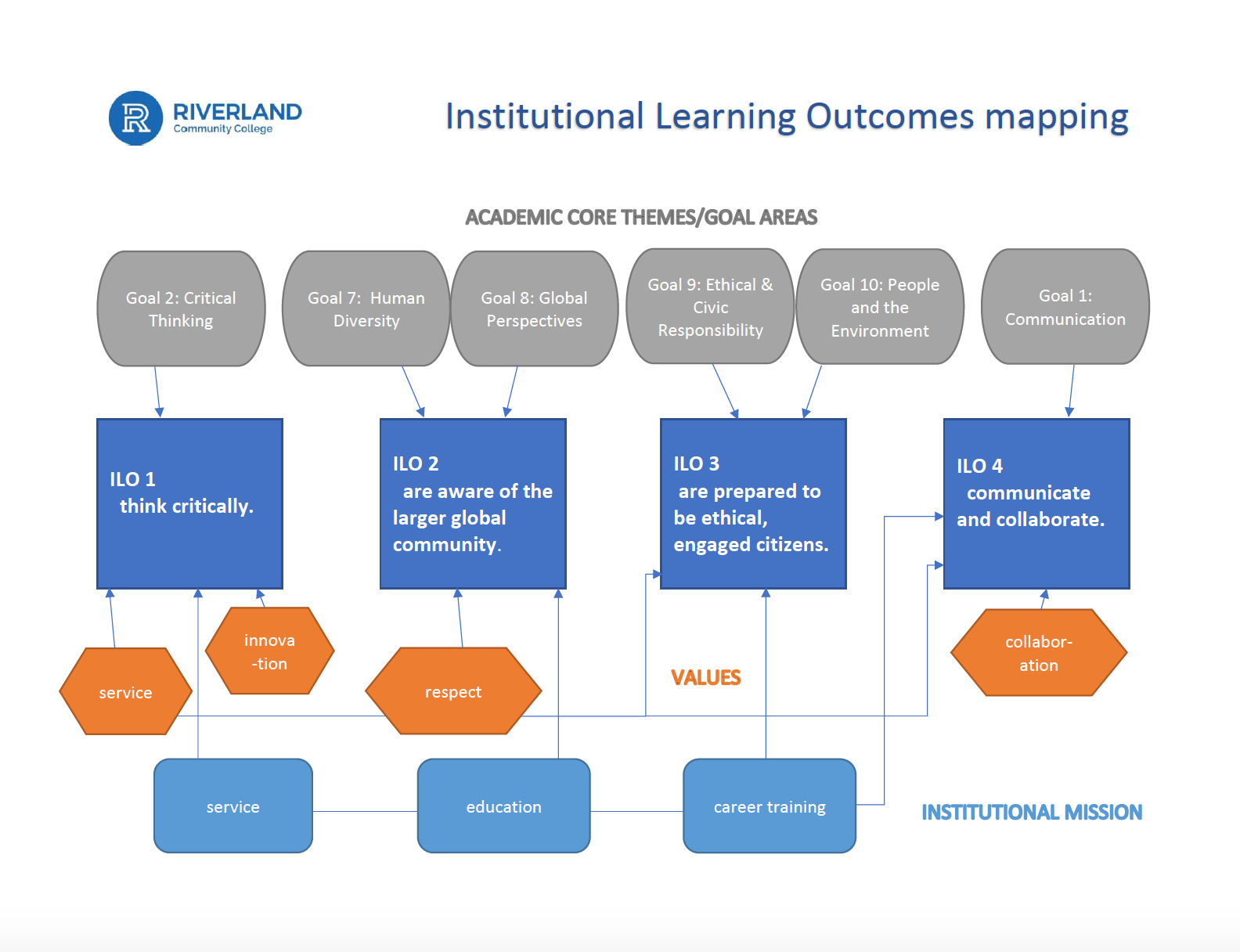
Core Themes and Discipline Areas/MnTC Outcomes Assessment
Using the Minnesota Transfer Curriculum (MnTC) as a model, Riverland has designed each course in its curriculum to fall into one of five Core Themes (Goals 2, 7, 8, 9, 10 below). Liberal Arts courses in the MnTC curriculum have their place in one of the five remaining MnTC Goal Areas (1, 3, 4, 5, 6), and are defined by the college as Discipline Areas. Each Core Theme and each Discipline Area goal has four to six associated student competencies. Riverland designed SLOAP as a systematic process and tool for measuring these competencies.
Riverland Core Themes for Classroom-Level Student Learning Outcomes
- GOAL 2: Critical Thinking – Riverland graduates are able to unify factual, creative, rational, and value-sensitive modes of thought.
- GOAL 7: Human Diversity – Riverland graduates understand individual and group differences.
- GOAL 8: Global Perspectives – Riverland graduates understand the growing interdependence of nations and peoples and develop their ability to apply a comparative perspective to cross-cultural social, economic and political experiences.
- GOAL 9: Ethical and Civic Responsibility – Riverland graduates have the capacity to identify, discuss, and reflect upon the ethical dimensions of political, social, and personal life and to understand the ways in which they can exercise responsible and productive citizenship.
- GOAL 10: People and the Environment – Riverland graduates understand today's complex environmental challenges.
Riverland Discipline Area Goals for Classroom-Level Student Learning Outcomes (Liberal Arts areas)
- GOAL 1: Communication – Riverland graduates utilize the English language effectively and read, write, speak, and listen critically.
- GOAL 3: Natural Sciences – Riverland graduates understand natural science principles and methods of scientific inquiry.
- GOAL 4: Mathematics/Logical Reasoning – Riverland graduates know mathematical and logical modes of thinking.
- GOAL 5: History and the Social and Behavioral Sciences – Riverland graduates know how historians and social and behavioral scientists discover, describe, and explain the behaviors and interactions among individuals, groups, institutions, events, and ideas.
- GOAL 6: The Humanities and the Fine Arts – Riverland graduates know human conditions and human cultures, in relation to behavior, ideas, and values expressed in works of human imagination and thought.
Visit the Minnesota Transfer Curriculum Goals 1–10 page to see all competencies associated with each Core Theme.